Understanding the Female Cycle
The menstrual cycle is a complex and fascinating process that plays a vital role in female reproductive health. It involves a coordinated interplay of hormones between the brain and ovaries, ultimately leading to the preparation of the uterus for potential pregnancy.
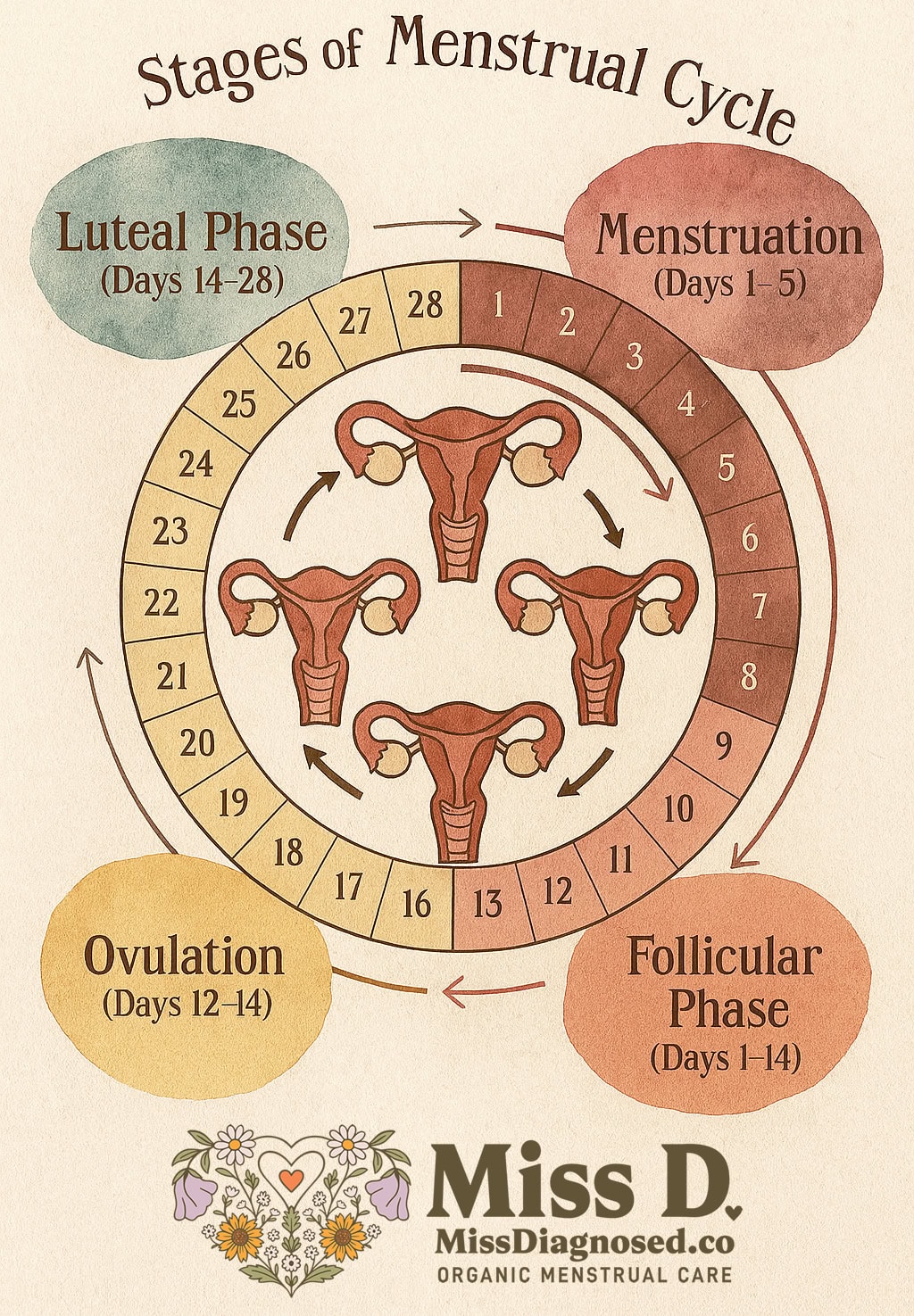
The cycle is typically divided into two parallel processes: the ovarian cycle and the uterine cycle.
But I wasn’t alone. And neither are you.
MissD is the voice I needed when I was younger. Now in my mid-40's, I’ve become the advocate I once searched for—dedicated to helping young women understand that their cycles are not a curse, but a beautiful part of their womanhood. It’s time we tend to our bodies the way we would a garden: with intention, love, and gentleness.
The Ovarian Cycle
This cycle governs the development and release of an egg from the ovary and has three phases:
1. Follicular Phase: This phase begins on the first day of menstruation and lasts until ovulation, typically around day 14 in a 28-day cycle.The pituitary gland, stimulated by gonadotropin-releasing hormone (GnRH) from the hypothalamus, releases follicle-stimulating hormone (FSH). FSH stimulates the growth of several ovarian follicles, each containing an immature egg.
One follicle becomes dominant and matures, releasing increasing amounts of estrogen.
Rising estrogen levels inhibit FSH production, causing other follicles to degenerate.
2. Ovulation: This phase, occurring around day 14, is marked by a surge in luteinizing hormone (LH) triggered by high estrogen levels. The LH surge causes the dominant follicle to rupture and release the mature egg into the fallopian tube. Some women may experience mild cramping or spotting during ovulation.
3. Luteal Phase: This phase begins after ovulation and lasts until the start of the next menstrual period, typically about 14 days. The ruptured follicle transforms into a structure called the corpus luteum.
The corpus luteum produces progesterone and some estrogen, preparing the uterine lining for potential implantation. If pregnancy doesn't occur, the corpus luteum degenerates, leading to a drop in progesterone and estrogen levels.
The Uterine Cycle
This cycle focuses on the changes in the uterine lining (endometrium) in response to the ovarian hormones, preparing it for a potential pregnancy.
Menstruation: This phase begins on day 1 of the cycle with the shedding of the uterine lining, expelled as menstrual bleeding (your period). This occurs due to the sharp drop in estrogen and progesterone levels at the end of the previous luteal phase.
Proliferative Phase: This phase overlaps with the follicular phase of the ovarian cycle and lasts from the end of menstruation until ovulation. Rising estrogen levels stimulate the regrowth and thickening of the uterine lining, preparing it to receive a fertilized egg. The uterine lining becomes richly supplied with blood vessels and glands.
Secretory Phase: This phase corresponds to the luteal phase of the ovarian cycle, occurring after ovulation. Progesterone, secreted by the corpus luteum, transforms the endometrium, making it receptive to implantation. Uterine glands become more complex and secrete glycogen and mucus, further nourishing the lining. Hormone interplay and feedback. The menstrual cycle is orchestrated by a delicate dance of hormones: GnRH (from the hypothalamus) stimulates the pituitary to release FSH and LH.
- FSH promotes follicle development. LH triggers ovulation and corpus luteum formation.
- Estrogen (from follicles) rebuilds the uterine lining and ultimately triggers the LH surge.
- Progesterone (from the corpus luteum) prepares the lining for implantation and, along with estrogen, inhibits the release of GnRH, FSH, and LH in the luteal phase.
If fertilization and implantation occur, the embryo releases human chorionic gonadotropin (hCG), which maintains the corpus luteum and progesterone production, preventing the uterine lining from shedding. If not, the corpus luteum degenerates, hormone levels fall, and the cycle restarts with menstruation.
Our Vision
A world where young women are confident in their cycles, educated in their anatomy, and supported in their self-care—without embarrassment, confusion, or silence.
We envision periods as a milestone, not a mystery. A celebration, not a secret.
Who We’re For
For every stage of the journey:
Teen girls starting their cycle, supportive parents, conscious women, and those facing challenges like endometriosis, PCOS, or irregular cycles—this space is yours.
Our Impact
A portion of every purchase supports menstrual equity efforts in underserved communities. We believe all girls deserve access to safe, organic menstrual products and education—regardless of their background or zip code.

From Me to You
This is more than a brand—it’s a conversation. A space for compassion, connection, and growth.
Thank you for being here.
Thank you for honoring your body.
Let’s grow together. 🌱
—MissD♥️